
contrast therapy: why hot then cold, and in that order
26 Aug 2026 · sundaymood
contrast therapy: why hot then cold, and in that order
Heat opens, cold closes, and doing it in that order is the entire point. What contrast therapy actually does, how long to spend in each, how many rounds to do, and where the science is solid rather than sold.
Almost everyone arrives with the same instinct: the cold is the hard part, so get it over with first.
It is the wrong way round, and not for reasons of willpower. The order is the mechanism. Heat first, cold second, repeat if you feel like it. Do it the other way and you still get a cold bath and a warm room, but you lose most of what makes the pairing worth an hour of your week.
Here is what is actually happening, why the sequence matters, and where the evidence is genuinely strong as opposed to merely popular.
what contrast therapy is
Contrast therapy means deliberately alternating heat and cold, usually with the heat first and a longer stretch in the heat than in the cold.
Your circulatory system responds to temperature. In heat, blood vessels near the skin widen to shed warmth, so blood moves outward and your heart rate climbs to something like light exercise. In cold, those same vessels clamp down to protect your core, pushing blood inward toward your organs.
Alternating between the two makes that happen on purpose, and repeatedly. Vessels widen, then narrow, then widen again. It is a mild, rhythmic demand on a system that spends most of its life in an air-conditioned room at a constant 24°C, never asked to do anything in particular.
That rhythm is the thing people are chasing. Not the heat on its own, not the cold on its own.
why the heat comes first
Four reasons, and they compound.
Your tissue is warm and pliable. Forty minutes of heat leaves muscle warm, joints looser and blood moving freely. Cold applied to warm, dilated tissue produces a real swing. Cold applied to a cold body at nine in the morning produces a smaller one and a much worse time.
The swing is where the effect lives. The whole point is the change of state. Starting cold means starting from roughly where you already are, so there is very little change to make.
Cold first blunts what follows. Step into 7°C water cold, and you spend the next twenty minutes in the sauna recovering rather than benefiting. Your body is chasing its own temperature back rather than settling.
It is easier, and easier means you actually do it. A warm body meets cold water far better than a cold one. The first fifteen seconds are still the first fifteen seconds, but they pass. This matters more than it sounds: the protocol you keep doing beats the ideal one you avoid.
There is one common exception worth naming. If you have an acute injury, a fresh sprain or a swollen joint from this morning, cold on its own is the appropriate treatment and heat is not. Contrast therapy is for general recovery and for feeling well, not for an injury that happened a few hours ago.
the actual protocol
No mystique here. This is what most people settle into.
- Heat: 15 to 20 minutes. Our saunas run at 75 to 80°C. You want to be properly sweating, not merely warm. If you are checking the clock at minute four, that is your first session talking, not a problem.
- Cold: 30 seconds to 3 minutes. Ours holds at 7°C, filtered continuously. Thirty seconds is a real round, not a token one. Very few people need more than three minutes and there is no prize for it.
- Rounds: two or three. Heat, cold, heat, cold. On a 60-minute session, two rounds is comfortable. On a 90, three fits without rushing.
- Rest between: a minute or two, sitting, breathing normally, letting your body do the work. The rest is part of it rather than a gap in it.
Shower before you get into the water, always. Get in slowly and breathe out longer than you breathe in, because the gasp reflex is a reflex and a long exhale is what overrides it.
finishing hot or finishing cold
The one genuine debate, and it comes down to what you want from the rest of your day.
Finish cold and you leave alert. The cold triggers a sharp rise in norepinephrine, which is why people describe a clean, almost buzzy focus afterwards that has nothing to do with caffeine. Good for a morning session before work.
Finish warm and you leave loose and heavy in the good way. The gentle drop in core temperature over the following hour or two is a strong sleep signal, which is why an evening session so often produces the best night of sleep in a week.
Neither is more correct. We would suggest finishing warm if you are coming after 6pm, and finishing cold if you are coming before work. Try both and your own preference will make itself obvious by the second or third visit.
what the evidence supports, and what it does not
Worth being straight about, because a lot of what circulates online is enthusiasm rather than research.
Reasonably well supported: contrast and cold water immersion reduce the muscle soreness that shows up a day or two after hard training, and people report feeling recovered sooner. Regular sauna use is associated in large long-running Finnish population studies with better cardiovascular outcomes, though association is not the same as proof and those were traditional saunas rather than infrared. Heat is a reliable route into a parasympathetic, rested state, which is most of why an hour of this feels the way it does.
Genuinely mixed: claims about immunity, detoxification and metabolism. Sweating is temperature regulation. Your liver and kidneys handle detoxification, and they do it whether or not you sweat.
Worth knowing if you lift: cold water immersion in the couple of hours straight after resistance training appears to blunt some of the muscle-building adaptation you trained for. If you are in a strength block, take the cold on rest days or several hours after the session, and use the sauna alone on lifting days. On endurance days it matters much less.
Always: if you are pregnant, have a heart condition or a chronic condition, or take medication that affects how you handle heat, talk to your doctor before booking. This is general information rather than medical advice, and we would rather say so plainly.
why we do it in a private room
Contrast therapy needs the two things next to each other. That sounds obvious, but it is exactly what most gyms cannot offer: a sauna on one floor, a cold shower somewhere else, and a queue.
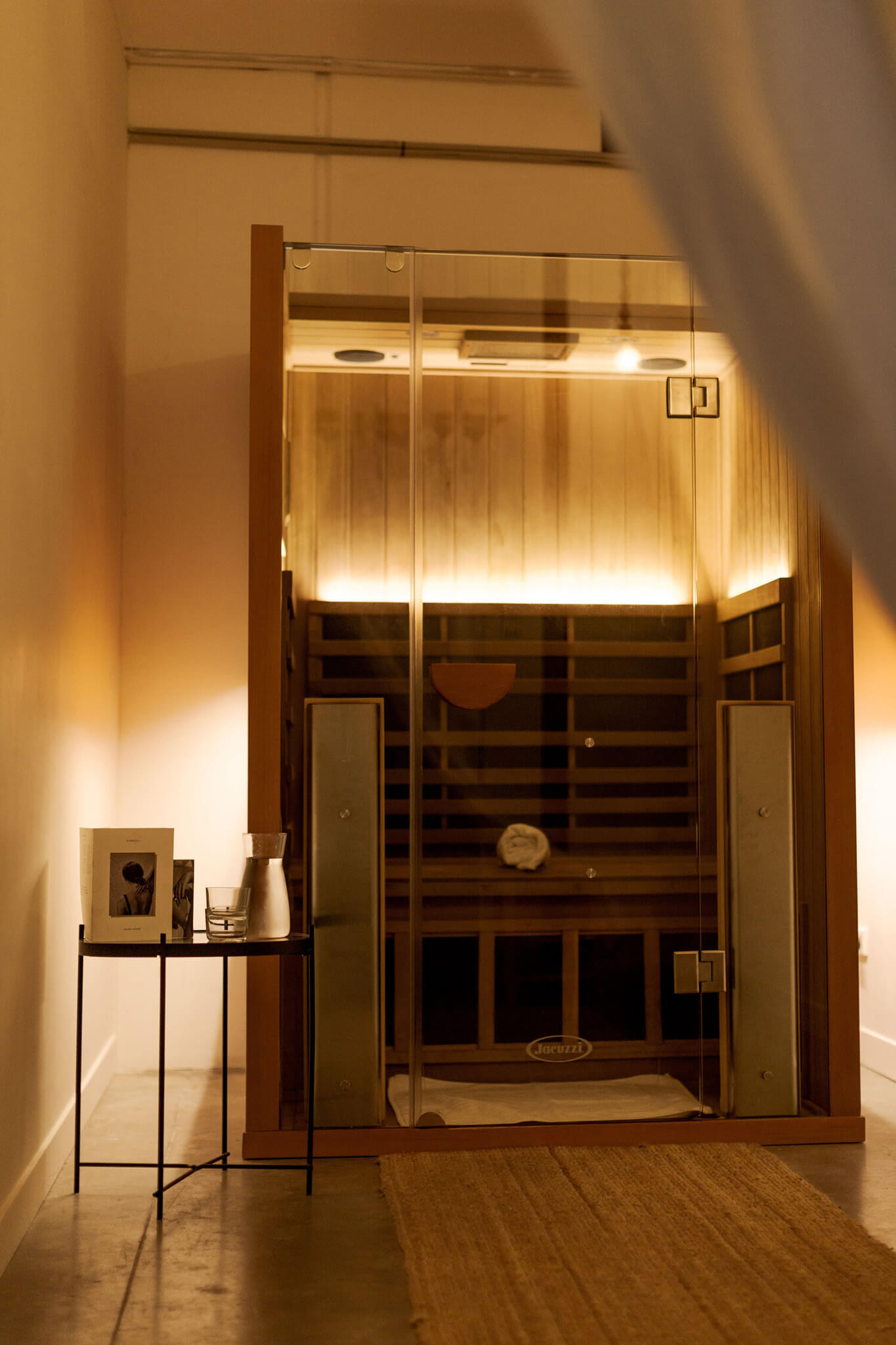
Every suite here has an infrared sauna, a cold plunge, a hot rain shower and a changing area behind one door that is yours for the whole session. You can go back and forth as many times as you like, at whatever pace you like, without waiting for anyone or being watched by anyone. The bluetooth speakers and coloured lighting are yours to set.
A single 60-minute session is THB 1,200 and 90 minutes is THB 1,800, with the whole suite yours for the duration. If it becomes a habit, the packs bring it down considerably: seven sessions for THB 6,800, fifteen for THB 12,000, thirty for THB 20,000. There is also a monthly membership at THB 18,000 for 30 credits in 30 days. Full detail on pricing and packages.
You can bring someone, up to two extra people on a 60-minute session and three on a 90, at THB 400 each.
questions we get asked
Do I have to do the cold part?
How long should I stay in the cold?
How many rounds should I do?
Should I finish hot or cold?
Can I do contrast therapy every day?
Is infrared different from a traditional sauna for this?
ready when you are. book a session, or come and see the space first. we got you.